
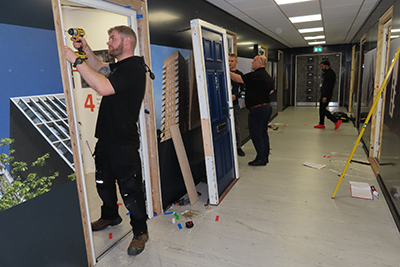
Nicola John, Managing Director of Fire Door Maintenance (FDM) Training and Development, explains the risk of the long-standing industry reliance on on-the-job training and the need to meet legislation by blending on-site, hands-on experience with vocational qualifications.
Over the past few years, the construction and fire safety sectors have experienced an unprecedented reassessment of how competence is defined, developed, and demonstrated. The Building Safety Act (BSA) and subsequent secondary legislation have profoundly shifted the competency landscape, demanding not only experience but provable competence. To support competency across the sector, the British Standards Institution (BSI) defines competence through four core pillars of knowledge, skills, behaviours, and experience (SKEB) and sets out how these can be evidenced in practice.
The Competency Conundrum
The SKEB framework calls for a fusion of practical skills, theoretical understanding, application of skills and professional conduct to define, assess and evidence professional competence. This all-encompassing approach to competence calls into question the industry’s traditional reliance on purely learning on the job, highlighting that this approach, in isolation, is no longer sufficient. While, of course, hands-on learning remains invaluable, a more blended approach is now needed to meet the heightened compliance, accountability, and scrutiny of the BSA.
To prove they’re capable of delivering a role safely and effectively, individuals and organisations operating across the construction supply chain should be able to clearly demonstrate their competency by meeting each component of the competency model. And this is a major cultural and practical shift.
The Problem of Experience Alone
For decades, on-the-job learning has been the mainstay of professional development in construction, but the Grenfell Inquiry illustrated the risks of this limiting approach. Fire doors, a critical last line of defence in compartmentalisation, have often been compromised by minor errors that should never have happened. From incorrectly fitted door closers to improper hardware replacement and gaps between door frames and walls, each error, albeit seemingly small, can result in devastating consequences during a fire.
Most fire door training still relies heavily on on-the-job learning or short theory-based classroom courses, rather than practical application. It’s also possible to achieve a Level 3 qualification without ever installing or inspecting a fire door under real-site conditions, which only provides a misleading sense of security and fails to build or verify competence. While this training is well-intentioned, it doesn’t meet the BSA’s requirements and results in insufficient knowledge across the fire door supply chain.
Sealing Knowledge Gaps
Published in February this year, the Government’s Construction Products Reform Whitepaper highlighted the persistent lack of competence across the supply chain, from product design to installation. To address this and truly develop and demonstrate competence, a cultural transition towards a blended approach and structured, continuous professional development is needed for those involved with fire doors across the supply chain. For those who install fire doors, this could look like a mix of on-site mentoring and shadowing for new recruits, accredited courses that reinforce technical knowledge and an increased focus on evidence-based vocational qualifications that support the full SKEB framework.
Vocational Training
Vocational qualifications mix theoretical knowledge with practical training and assess and validate skills and understanding under real-life conditions. By focusing on hands-on, practical training along with theoretical and regulatory knowledge, vocational qualifications help ensure learners are job-ready. This type of training often enhances employability and career growth for the learner and, due to its practical nature, also helps to develop transferable skills such as time management, people management and teamwork – essential skills for any working environment. Vocational training allows trainees to apply theoretical knowledge in real-life scenarios, work with others to navigate on-site issues, and practice successful outcomes.
Vocational training is suitable for learners at any level, from a new starter to an experienced team member. Qualifications are industry-specific and are written to maintain alignment with changing legislation and standards. The combination of theory with hands-on training, evidence collection, mentoring, observation, and professional discussion enables the trainee to experience and practice practical applications and allows the assessor to see firsthand that the candidate can put theory into practice.
Both accredited training courses and regulated qualifications offer those working with fire doors a structured learning process, recognised assessment and proof-of-skill certification. A wide range of vocational courses and qualifications are available across the full fire-door lifecycle, covering design, procurement, installation, inspection, repair and maintenance. This type of training is designed to formalise and improve knowledge, fill gaps, and demonstrate expertise, with FDM’s regulated diplomas providing a clear and complete route to competence in fire door inspection and installation.
Vocational qualifications are a key enabler of the much-needed mindset change away from our tick-box culture, helping embed the knowledge, behaviours and professional culture the BSA aims to deliver.
An Opportunity for Change
It’s easy to regard the BSA as burdensome, but when viewed through an improvement-focused lens, it presents an extraordinary opportunity to transform industry standards. By blending on-the-job mentoring with formalised vocational training and hands-on learning, organisations can create a workforce that’s not only experienced but also fully equipped, assessed, and confident in their roles. This comprehensive model will help to elevate safety outcomes and reduce risk across the supply chain.
With the BSA now enforcing personal accountability, ambiguous assurances of competence are no longer good enough; organisations must be able to provide clear, verifiable evidence of their people’s capabilities. The jigsaw of competence is complex, but with every piece thoughtfully placed, safer buildings and stronger reputations will result.
Elevating Standards
The fire safety sector is beginning to follow the example of other high-risk industries that have successfully led their own competency revolutions, with vocational qualifications offering a credible, evidence-based path to lasting improvement. A short course or an exclusively theory-based course with no practical, hands-on element simply can’t bear the full evidential weight required under the BSA. Vocational qualifications produce a credible, transparent, and defensible record of competence, which is vital in an industry where safety can’t be compromised, and where non-compliance could lead to fines, imprisonment and personal criminal liability.
In fire safety, raising the regulatory bar is necessary and should be viewed as an opportunity for improvement. With higher expectations comes better training delivery, a culture of continuous learning, and renewed professional pride across the supply chain. Organisations that embrace a blended model of capability training and development will be better placed to close the competence gap and deliver the demonstrable competence the BSA demands.

