
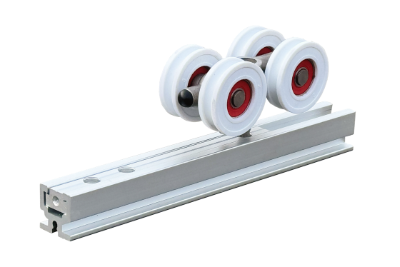
In many residential and commercial environments, sliding and folding door hardware appears to be disappearing; but this vanishing act is no accident. Concealed door systems are a deliberate design choice reflecting modern project requirements, explains David Knollman of Brio UK.
Once considered premium or niche, concealed sliding and folding door systems have become a widely selected option for projects where architectural cohesion is essential. As specifiers and end users alike continue to prioritise uninterrupted sightlines, refined visual details and space-saving properties, concealment offers a compelling answer.
Concealed sliding and folding door hardware systems are engineered to integrate seamlessly into the fabric of a building, with tracks and mechanisms hidden within ceilings, walls or door leaves. By this effect, doors appear almost weightless as they open and close and offer spaces a more refined aesthetic. This provides real value to spaces looking to combine functionality with a minimalist artistic style, where in comparison, systems with exposed tracks, hinges and rollers can interrupt - or even dominate - the visual scheme.
The shift towards concealed hardware is not a stylistic choice alone. Specification teams can now deliver tangible performance benefits too, with advanced solutions supporting controlled movement in multi-functional settings. Reliable concealed tracks and roller mechanisms help to ensure smooth operation even in the most demanding or high-traffic environments, such as open-plan homes, offices and hospitality venues, where sliding and folding doors are frequently used to reconfigure spaces.
Flexibility is an advantage offered by concealed systems too. Modern applications support wider openings and adaptable layouts and are able to accommodate any number of panels on single or multiple lines of rail. In compact residential settings, concealed doors can maximise the usable floor area by eliminating the clearance that is required by traditional hinged doors, and in doing so, help to create a more open, welcoming and efficient living space.
Safety is another characteristic of concealed hardware, whereby housing the moving components of a system within the door, ceiling or floor structure, the risk of accidents can be reduced. This is particularly beneficial in residential or public-facing environments, where users are varied in age and ability and interaction with the door is frequent. Soft-close and damping technologies are now often integrated within concealed systems too as a way of further enhancing operational control, improving both safety and user experience in the process.
From an installation perspective, today’s concealed hardware solutions are designed with simplicity in mind. Modular components and pre-engineered kits make installation more predictable, improving the accuracy of fittings and reducing on-site complexity. This approach helps to ensure hardware performance standards are retained long after the initial installation period.
Ultimately, the growing adoption of concealed door hardware demonstrates how form and function can successfully align. As projects demand high aesthetic standards and practical usability, these modern systems are playing an integral role in creating visually coherent spaces that are both adaptable and efficient. And so, concealed sliding and folding door hardware is set to remain a defining feature of contemporary architecture, delivering performance and complementing design without demanding attention.

