
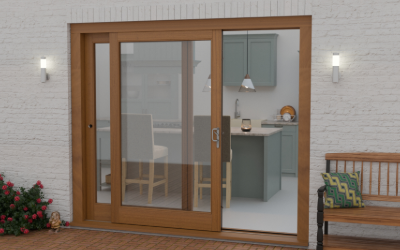
As professionals continue to push the boundaries of contemporary architecture, doors remain a focal point of design, but what about the hardware behind the application? David Knollman of Brio UK explores this connection and highlights the unique specification considerations for sliding and folding door systems.
Doors are symbolic with making an entrance. They play a natural role in establishing the first impression of any space and swiftly help users to determine their opinion on a room and its surroundings. Sliding and folding doors have risen in popularity for this very reason.
When utilised as a design choice, sliding and folding doors are proficient in setting the tone for a project. There are key distinctions between them, but both systems are valued for their ability to complement an aesthetic scheme whilst enhancing light flow and maximising usable space. With their unique profiles used to create and define modern entry spaces, much of the focus can often sit with the presentation of the door itself. Yet, it is the hardware behind the door that is fundamental to the installation’s success.
Hardware shapes the space
There’s no doubt that sliding and folding door applications shine from a visual standpoint, but how they operate, perform and appear over time is equally important. With a growing range of styles, sizes and configurations available, accurate hardware specification has become crucial to retaining the levels of performance and aesthetic value that modern projects demand. But where should the specification process begin?
The first step is recognising how different door solutions may respond to user and space requirements. Sliding doors, for example, are often favoured for their clean, minimal aesthetic and are commonly used in rooms where wall space allows panels to glide past one another, providing uninterrupted views and a tidier opening. Sliding configurations are typically constructed of fewer panels, and as such, are well suited to residential living areas and commercial offices where ease of use and unobtrusive operation are required.
Folding doors on the other hand, provide the ability to fully open an aperture. Panels collapse and stack neatly, making them well suited to applications where maximum connectivity between spaces is desired, such as large interior openings or the passageway between indoor and outdoor environments. Whilst often lightweight in design and offering greater areas of access, folding doors typically demand more from the hardware, with multiple moving panels, hinges and pivot points requiring careful coordination upon use.
In any case, understanding who may use the door, its location and how frequently it may be operated should be the first stage of hardware selection. Track systems, rollers, guides and soft-close mechanisms contribute significantly to user experience by influencing how smoothly, quietly and safely a door will operate. Appropriately specified, high quality hardware will help to ensure consistent alignment and reliability throughout the door’s lifecycle. In contrast, poorly specified systems may lead to doors that are difficult to operate or are prone to misalignment - quickly undermining the design intent of any space.
Avoid technical neglect
The correct specification of sliding and folding doors goes further than project requirements alone. Modern systems are precision crafted, with each configuration carefully designed to serve a different purpose, and it is often the technical capabilities and performance options that can leave a lasting impression on a space.
Weight is one of the most critical, yet undervalued specification details. In many contemporary projects, larger door leaves are freely combined with materials such as timber, aluminium and glass to achieve eye-catching visuals. However, this places a higher demand on the door hardware supporting them. As door size and weight increases, so too must the load capacity of the hardware, with more robust track systems and rollers able to carry the required weight whilst maintaining smooth operation upon use. For folding systems in particular, weight distribution is vital. Panels are connected through various hinges, and the chosen hardware must manage both vertical and lateral movement without compromising alignment. Failure to account for weight can lead to sagging panels and excessive wear, impacting the door’s operation over time.
Similarly, opening dimensions and structural conditions must also be addressed. Trusted manufacturers will define the maximum panel width, height and thickness suitable for their hardware, certifying the usability of a system and ensuring its reliability post-installation. Environmental conditions can also impact hardware longevity. Long-term maintenance and the durability of materials will inevitably affect the usability of a system, and neglecting factors such as corrosion resistance may influence ongoing costs in the long run. With this in mind, choosing an appropriate material for an application in its setting, whether that be timber, aluminium or uPVC for either an internal or external door, requires balance between the unique characteristics each can offer.
Material choice impacts areas such as mechanism position and thermal performance too. When it comes to installation, timber will often be applied when using top hung folding door systems, with hinge pins extended up into the top rollers where required. By comparison, an aluminium system can accommodate a bottom roller housing within its panel profiles, and although timber variants can also be suitable, they may require bespoke bottom profiles or panel corner removal to house the roller system. With the mechanism position confirmed, it is also important to consider additional factors such as thermal performance. Both sliding and folding doors allow for improved airflow and ventilation, and thermal efficiency is later maintained when doors are closed. Timber upholds natural insulation, for example, whereas aluminium and uPVC systems are not inherently effective in these areas, but may offer additional durability in harsher environments.
Where visual themes and operational performance may direct early project discussions, it is also critical to meet the compliance needs of the building. Sliding and folding doors are designed in accordance with the performance requirements set by the Building Regulations in the UK (independent but similar requirements exist between England, Wales and Scotland, Northern Ireland), ensuring safety, security and energy efficiency credentials are in check. If an opening needs to be wheelchair accessible for example, the chosen application must conform to Approved Document M, providing enough space for those with limited mobility to pass through. Similarly, doors must not compromise the structural integrity of the building, and in many cases, must meet the set security standards for new structures in compliance with Product Assessment Specification (PAS 24) and Secured by Design (SBD) requirements.
Performance in these areas is paramount, but as professionals seek hardware that complements a project’s aesthetic, specification comes full circle back to design. In many cases, door hardware has become a statement, both visually and functionally and the details associated with finishes can often help professionals to reinforce their design intent. Matte black hardware has seen a significant rise in popularity in recent years for example, providing a bold and versatile option that is attractive in both residential and commercial spaces. Stainless steel finishes remain a popular choice for projects that favour a clean style and are highly effective in high-traffic areas or on exterior doors as a result of their robust durability and corrosion resistant abilities.
For any contemporary setting, door hardware can become a defining factor in how a space may function and feel. As teams continue to embrace larger openings and more flexible project installations, it’s important to focus on more than just the visual impact of the door. Only by looking beyond the door itself and considering the hardware that enables it to perform can professionals produce spaces that are as aesthetically striking as they are reliable, durable and comfortable to use.

