
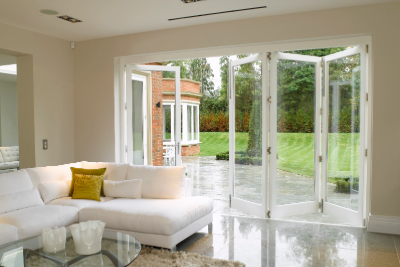
Folding door systems present a perfect blend of style and functionality to modern build projects, but what are the considerations to make when turning design ideas into practical solutions?
Today’s architectural professionals frequently grapple with the challenge of combining aesthetics and practicality. Where decision makers and end users alike seek a seamless blend between the two, folding door applications are identified by many as the missing piece to their design puzzle - but why?
Folding door systems go beyond the means of traditional hinged doors and can offer greater flexibility, accessibility and superior visuals whilst maximising the usable space of a room. Folding doors can be applied in a variety of settings too, with interior applications focusing on aesthetics, space efficiency and sound insulation and exterior systems prioritising the flow of movement, thermal performance and enhanced natural light.
To translate design ideas into viable, functional spaces requires an understanding of how different folding door systems are configured and their suitability for projects. In operation, a folding door will call upon its hinges and hardware to slide multiple panels along a track system, stacking them to one or both sides. With that, there are two key operational methods to consider.
Top hung systems are commonly found in interior applications and are designed to suspend panels from a head track for seamless operation, also reducing the need for a continuous floor track which can be an issue if a space has underfloor heating or ceramic tiles already installed. Bottom rolling systems, on the other hand, are ideal for projects where the overhead structure may not be strong enough to support the complete system.
Decision makers must also review the primary design variations of folding door systems. For instance, a Multifold 30 system - known as an inline system - is simpler to understand as panels typically share the same centreline as the top track and channel. Whilst being easier to install, these systems may not always be compatible with rebated frames. In contrast, Interfold systems - known as an offline system - typically has panels on a different centreline to the top track, allowing doors to open away from and back into a rebated frame. This option is better suited to external systems to improve weather resistance, as well as for internal systems that require acoustic, thermal or light reduction on one side compared to the other.
Where Multifold door systems may be easier to operate and provide neater stacking arrangements, Interfold systems can offer a more symmetrical visual effect when doors are open and provide greater balance which is useful in larger installations. Often, the choice between systems will come down to a project’s aesthetics, the available space and operational preference. Though, to truly unlock the host of benefits presented by folding door applications, decision makers must align their design vision with a technical understanding of the folding door systems available in today’s market.

